XIAMEN ACEY NEW ENERGY TECHNOLOGY CO., LTD.


Brand:
ACEYItem No.:
ACEY-BCT503R-512HCompliance:
CE CertifiedWarranty:
One-year warranty with lifetime supportOrder(Moq):
1 SetPayment:
T/TProduct Origin:
ChinaLead Time:
7-35 days
Product Description
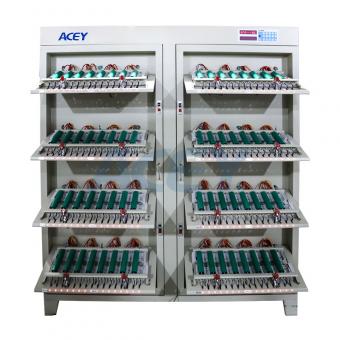
ACEY-BCT503R-512H tests the capacity and charge–discharge performance of cylindrical lithium-ion cells before battery pack assembly. Each of its 512 channels independently controls charging and discharging while recording voltage, current, capacity and test time. The software evaluates results against preset criteria to assign cell grades and identify abnormal cells.
Cells are placed horizontally in trays and secured using manually operated flat-head contact fixtures. With enlarged trays, the machine accommodates 18650, 21700, 26650, 32650, 32700, 32140 and 33140 cells within a diameter range of 18–33mm and a length range of 65–140mm.
The cabinet incorporates a bidirectional power system that returns discharge energy to the factory AC distribution network. Programmable test sequences, four-wire measurement and channel-level data management support repeatable capacity grading and production traceability.
Product Highlights
Cell Compatibility
| Configuration | Supported Range |
| Cell models | 18650, 21700, 26650, 32650, 32700, 32140, 33140 |
| Cell diameter | 18–33mm |
| Cell length | 65–140mm |
| Tray requirement | Enlarged trays |
| Cell positioning | Horizontal |
| Contact fixture | Flat-head type |
| Changeover requirement | Tray and contact settings matched to the selected cell |
Technical Specifications
| Item | Specification |
| Model | ACEY-BCT503R-512H |
| Equipment type | Regenerative cylindrical battery capacity grading cabinet |
| Cabinet color | White |
| Cell placement | Horizontal |
| Number of channels | 512 independent channels |
| Nominal channel configuration | 5V3A |
| Fixture type | Tray-based flat-head contact fixtures |
| Clamp operation | Manual |
| Compatible cell models | 18650 / 21700 / 26650 / 32650 / 32700 / 32140 / 33140 |
| Compatible cell diameter | 18–33mm |
| Compatible cell length | 65–140mm |
| Tray configuration | Enlarged trays required for the stated compatibility range |
| Voltage measurement range | DC 0–4.95V |
| Charging voltage range | DC 0–4.5V |
| Discharging voltage range | DC 2–4.5V |
| Constant-voltage setting range | DC 2–4.5V |
| Voltage accuracy | ±(0.05% of reading + 0.05% of full scale) |
| Voltage control / sampling resolution | 1mV / 1mV |
| Charging current range | DC 6mA–3A |
| Discharging current range | DC 6mA–3A |
| Current accuracy | ±(0.05% of reading + 0.05% of full scale) |
| Current control / sampling resolution | 1mA / 1mA |
| Current rise time | ≤50ms at 90% load |
| Channel startup time | ≤50ms at 90% load |
| Charging modes | Constant current / constant voltage / constant current–constant voltage |
| Discharging mode | Constant current |
| Programmable steps | Up to 32 |
| Programmable cycles | Up to 256 |
| Step duration | 0–3000 minutes |
| Time accuracy | ≤±0.1% |
| Data acquisition interval | Selectable from 1–60 seconds |
| Communication | RS485, 57,600 baud / TCP |
| Input power supply | Three-phase, five-wire AC380V ±10%, 50Hz |
| Maximum power consumption | ≤9kW |
| Energy recovery | Discharge energy returned to the factory AC distribution network |
| Power conversion efficiency | Charging ≥80%; discharging ≥70% |
| Cooling | Natural air intake with upward exhaust |
| Operating temperature | −10°C to 40°C |
| Relative humidity | ≤80% |
| Control computer | Customer supplied |
Software and Data Functions
Product Details


FAQ
*Can the same cabinet handle both 18650 and 33140 cells?
Yes, with the enlarged tray configuration. The fixture settings must be adjusted for the selected cell’s diameter, length and terminal structure. ACEY confirms the changeover requirements using the actual cell specifications.
*Is 3A sufficient for testing large cylindrical cells?
The required current depends on the cell capacity, specified test rate and acceptable cycle duration. A cell fitting the tray does not automatically make 3A the right production test current. ACEY reviews these requirements before recommending this model or a higher-current configuration.
*What determines the actual energy savings?
Savings depend on the discharge energy available for recovery, conversion efficiency, test sequence and equipment utilization. The regenerative function returns energy during discharge; it does not imply a fixed percentage reduction for every test procedure.
 5V3A 5A 6A 256/512 Channel Cylindrical Batteries Charging And Discharging Tester For Battery Pack Assembly
This battery testing machine can be used for cylindrical battery pack's capacity, internal resistance, charging and discharging test, etc.
 512 Channel Battery Cell Charge Discharge Tester for 18650 21700 26650 32700
This battery testing machine can be used for cylindrical battery pack's capacity, internal resistance, charging and discharging test, etc.
 512 Channel 5V 6A BFGS Lithium ion Battery Formation And Grading System
Lithium ion Battery Formation And Grading System is an instrument used to test the performance of batteries. Its main function is to evaluate the capacity, internal resistance, voltage, energy, temperature, and other parameters of batteries, as well as to detect any damage or defects in the batteries.
 256 Channels 5V 20A Energy Saving Feedback Cylindrical Cell 33140 Capacity Grading Machine
This battery testing machine can be used for cylindrical battery pack's capacity, internal resistance, charging and discharging test, etc.Suitable for Cylindrical Cell 32140 33140 etc.
 Lithium Ion Battery Cell Capacity Grading Machine
Different channels can be customized according to customer requirements, and the current and voltage are unified, its suitable for mass production.
 5V 6A Li-Ion Battery Cell Cycle Tester For 18650 21700 26650 32700
ACEY-BCT506R-512H lithium ion cell grading machine offers an efficient, energy-saving solution for 18650/21700/26650/32650/32700 battery formation and grading, significantly reducing operational costs with its intelligent power recycling system.
 512 Channels 5V 5A Lithium Battery Cylindrical Cell Charging Discharging Testing Machine
5V 1A 2A 3A 5A 6A 512 Channels Li-ion battery charging and discharging test cabinet is a kind of equipment used to test the charging and discharging performance of Li-ion battery. It is usually composed of power supply system, load system, control system, data acquisition system, etc.
 32140 33140 5V 10A Battery Charge Discharge Tester
256 Channel 5V 10A 20A battery charge discharge tester is used for 32140 33140 34189 cylindrical battery's capacity, internal resistance, charging and discharging test, etc.
Rm703, No.223, Qishan North Road, Huli District, Xiamen, Fujian, China
Email : allen@xmacey.com
Tel : +8618950009155
Whatsapp : +8618950009155